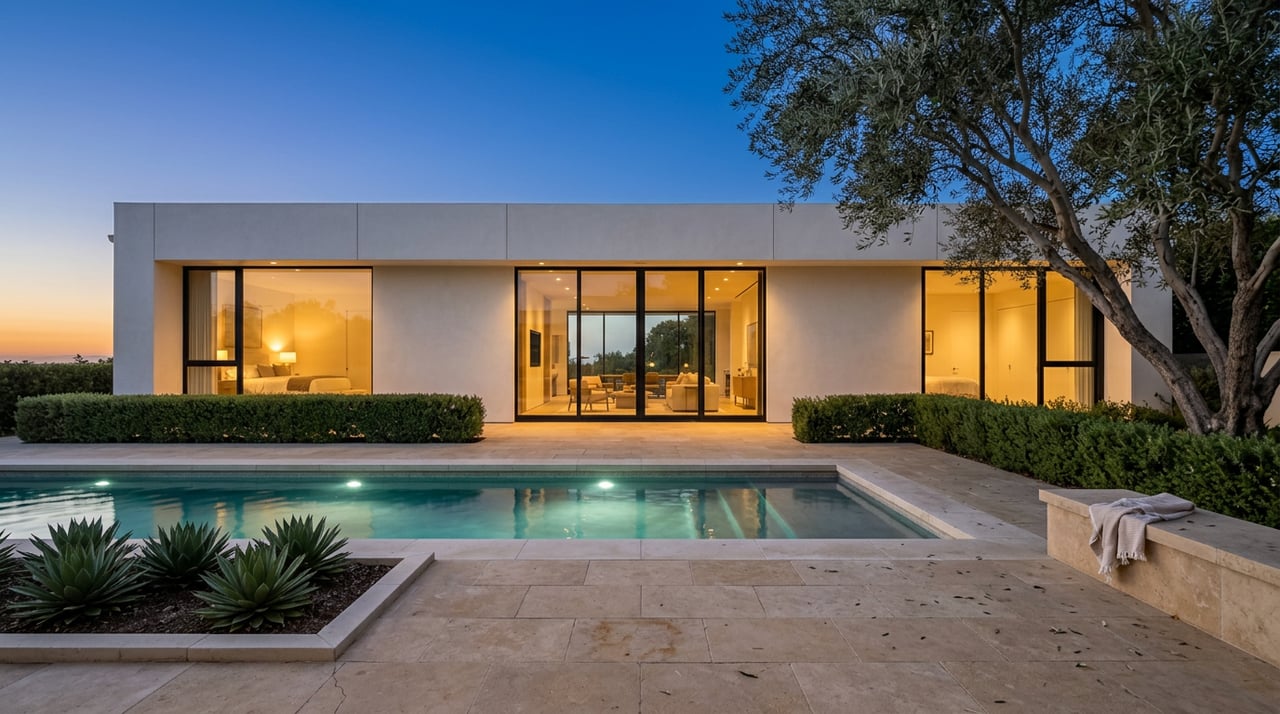
In the guard-gated luxury enclave of Pelican Crest, the custom built property at 36 Pelican Crest Drive was listed for just shy of $50 million in July 2025. The 13,206-square-foot estate, built in 2003 and once featured in Architectural Digest, sat on the market through the fall and into winter. By February 2026 it had fallen to $31.9 million when it finally went into contract. The sale closed on March 27, 2026, at $30 million, roughly 40 percent below the original ask and 244 days after it first hit the market.
A few doors down, at 30 Pelican Crest Drive, a different story was written by the sale for $25.8 million, or $3,142 per square foot and a third home on the same private drive, 1 Pelican Crest Drive, sold by the Daftarian Group for $42 million in May 2025, the priciest sale in Orange County that year.
Three homes. One street. One market. Wildly different outcomes. If you're preparing to list here, that's the fact worth sitting with before you talk to anyone about a listing price.
A gate with 166 houses and no crowd of comps
Pelican Crest isn't a neighborhood in the way Corona del Mar or Laguna Beach are neighborhoods, with hundreds of transactions a year feeding a reliable price curve. A licensed appraiser who has worked the area describes the subject in plain field notes: 166 custom-built single-family homes, bordered by 3,674 acres of permanently protected open space that includes Crystal Cove State Park. That boundary was set decades ago and it isn't moving. The homes here were built between 1999 and 2013, and the gate has been effectively closed to new construction ever since.
Zoom out to the broader Newport Coast luxury tier and the scarcity compounds with approximately 30 to 50 sales closing across the entire area in a given year, which works out to roughly one qualifying comp every seven to twelve days, spread across ridgelines, view orientations, and lot depths that have almost nothing in common with each other. Pelican Crest is a small, closed subset of that already-thin pool. In a typical month, a seller here might be pricing against one or two genuinely comparable closings, if that.
That's the condition that produced both the $3,142-per-square-foot record and the $2,272-per-square-foot close on the same street in the same rough window. Neither number describes "the market." Each one describes a single house and the handful of people who wanted it.
What the record sale actually measured
The 30 Pelican Crest Drive sale is worth studying for what it reveals about how value is established at this tier. The home sat unsold for 238 days before attracting renewed attention and ultimately securing a buyer. The residence featured a unique layout for the community, with entertaining spaces on the lower level and bedrooms on the main floor, along with a French-style architectural that read as authentic rather than themed.
That last detail matters more than the price-per-square-foot number itself. The record was not set because Pelican Crest homes are now worth $3,142 per square foot. It was set because two buyers, independently, decided that a specific architectural vision was worth paying for, and there was no third bidder to test whether the number would have held. A seller who points to that sale and expects the same multiplier on a different floor plan, a different view corridor, or a different architectural pedigree is reading a signal that was never meant to generalize.
What 244 days and a $20 million cut actually measured
The 36 Pelican Crest Drive sale tells a different kind of story, and it's the one sellers need more urgently. Losing roughly $20 million off an initial ask over eight months isn't automatically evidence of a cooling market or an overpriced listing. It can just as easily be evidence of a house that was priced for a buyer pool that didn't exist at that number, in a gate where the next comparable sale might close on the other side of the property, at a completely different price point, for reasons that have nothing to do with the first house.
Newport Beach voters will decide in November whether to scale back the city's required new-housing numbers citywide, a debate The Real Deal has covered in the context of this very sale. For Pelican Crest, that policy fight is close to irrelevant. The gate stopped adding lots more than a decade ago. Whatever the city decides about future housing, the comp pool inside these 166 homes will not get meaningfully deeper. That permanence is exactly why days-on-market and price-per-square-foot will keep behaving erratically here, sale after sale, indefinitely.
Why the standard CMA breaks down above $8 million
A comparative market analysis works when there's enough transaction volume to smooth out the noise from any single deal. Above roughly $8 million in this market, that volume disappears. At that point, an agent isn't running a spreadsheet so much as building a case: this view tier, this lot depth, this architectural pedigree, compared against the two or three transactions anywhere in Newport Coast that share enough of those traits to be useful.
Automated valuation tools make this worse, not better. Zestimate-style models are trained on high-volume transaction data, and they systematically underweight ocean-view premiums, which can add anywhere from $800,000 to more than $5 million to a comparable footprint depending on whether the view is partial canyon, partial ocean, or full panoramic. A seller who anchors expectations to an online estimate is starting from a number that was never built to price a house like this one.
The off-market question, and the test that actually separates real from decorative
Every seller at this level will be pitched an off-market strategy, and most of those pitches are worth exactly nothing. A pocket listing only works if there's a real, active buyer behind it. Without one, going off-market just means giving up public exposure while gaining no offsetting advantage, since there was never a hidden buyer pipeline to trade for it. The honest test is simple: ask the agent to name the buyer. If they can't, that's your answer.
Pelican Crest, along with the neighboring Pelican Hill and Pelican Ridge gates, is one of the few pockets in Newport Coast where genuine off-market activity does happen, because the agent network covering these streets is small and tight, and active buyers for this tier tend to rotate through the same handful of representatives. But the upside of going public shouldn't be dismissed either. At the $4 million-plus level, the gap between one interested buyer and three competing for the same house can run from $400,000 to more than $1.2 million at close. That's not a rounding error. It's the entire argument for exposure over secrecy when a real bidding dynamic is possible.
Before you sign a listing agreement
A few things worth confirming before pricing gets set:
- Ask for the specific comps behind the number, not a neighborhood average. Above $8 million, the honest answer might be two sales, not twenty.
- If an off-market approach is proposed, ask who the buyer is. A real answer names a person or a firm. A vague answer is a red flag.
- Confirm the marketing budget matches the price tier. Homes above $5 million in this market typically warrant a marketing spend in the range of 0.1 to 0.3 percent of list price, covering architectural photography, a 3D tour, drone footage, and syndication to the outlets that reach genuine buyers at this level. Standard photography and an MLS listing alone won't move a house like this.
- Understand your own view tier's actual band, not the gate's. A front-row, full-panoramic lot and a canyon-facing lot two streets over are not the same asset, even inside the same 166-home boundary.
FAQ
Does a record price-per-square-foot sale mean Pelican Crest values just went up across the board? No. A single record sale describes one house and the narrow buyer pool that wanted it. With this few transactions closing per year, one outlier doesn't move the baseline for the other 165 homes.
Why would a house lose $20 million off its original asking price and still take 244 days to sell? Because in a market this thin, the first list price and the eventual sale price are set against completely different information. A price that looked defensible on day one can face zero real offers for months, and the eventual close reflects whatever buyer pool actually showed up, not the original comp assumptions.
Is off-market always the better choice for a Pelican Crest listing? Only when there's a verifiable buyer behind it. Without one, a public listing with a competitive marketing push tends to produce more real offers, and in a tier where buyer competition can add six or seven figures at close, that exposure is usually worth more than the perceived privacy of going quiet.
Pricing a home in a market this thin isn't a spreadsheet exercise. It takes someone who has priced these specific streets before, who can tell you honestly whether a comp actually applies to your view, your lot, and your buyer pool. If you're weighing a sale in Pelican Crest and want that kind of read before you commit to a number, Michael Balliet offers Request Private Client Access to walk through the comps that actually matter for your address.